Cabeza Patata: »We love to look at everything through characters«
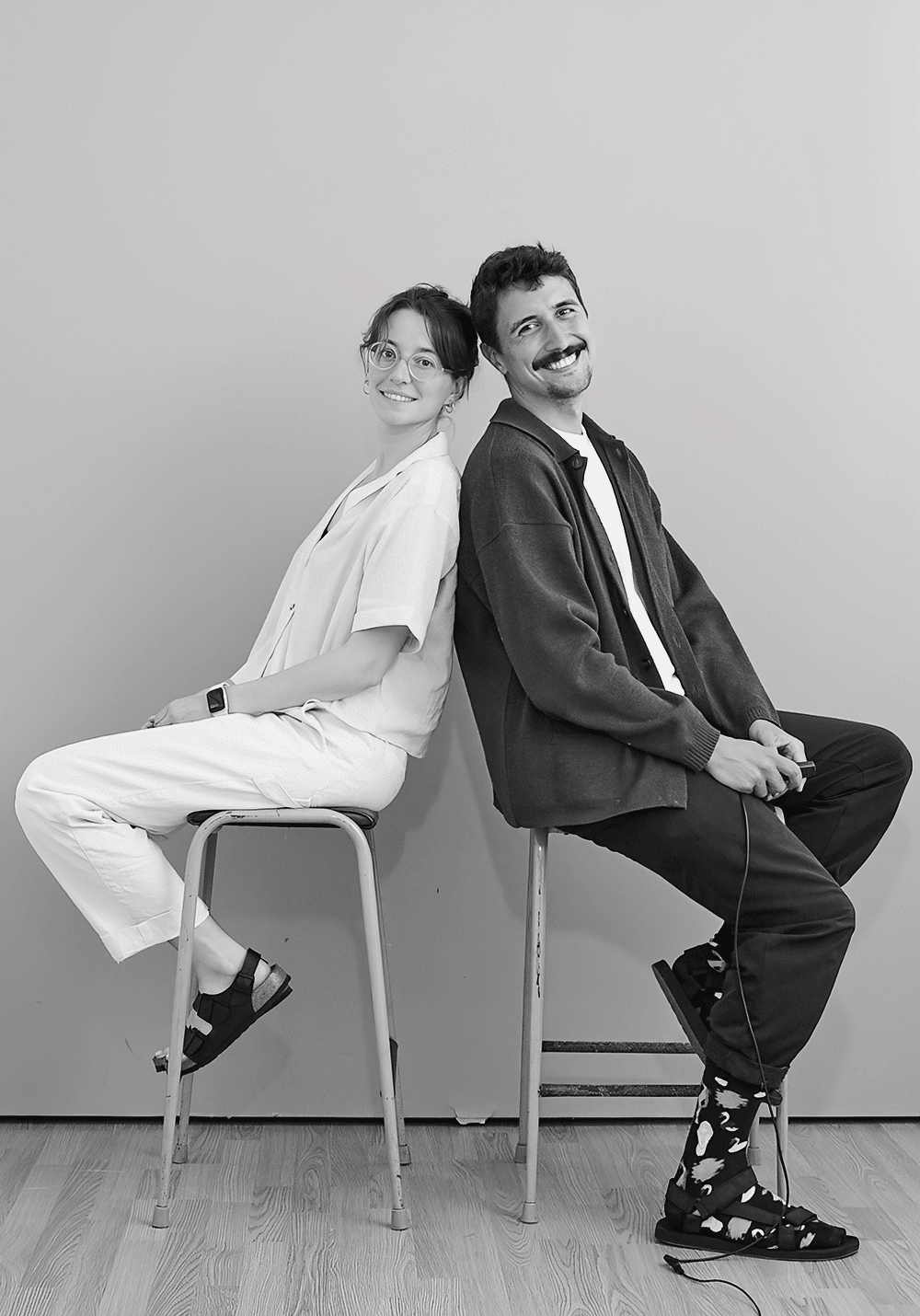
Katie Menzies and Abel Reverter were a couple before they started working together for fun – now, they are Cabeza Patata, one of the most successful character design studios worldwide.
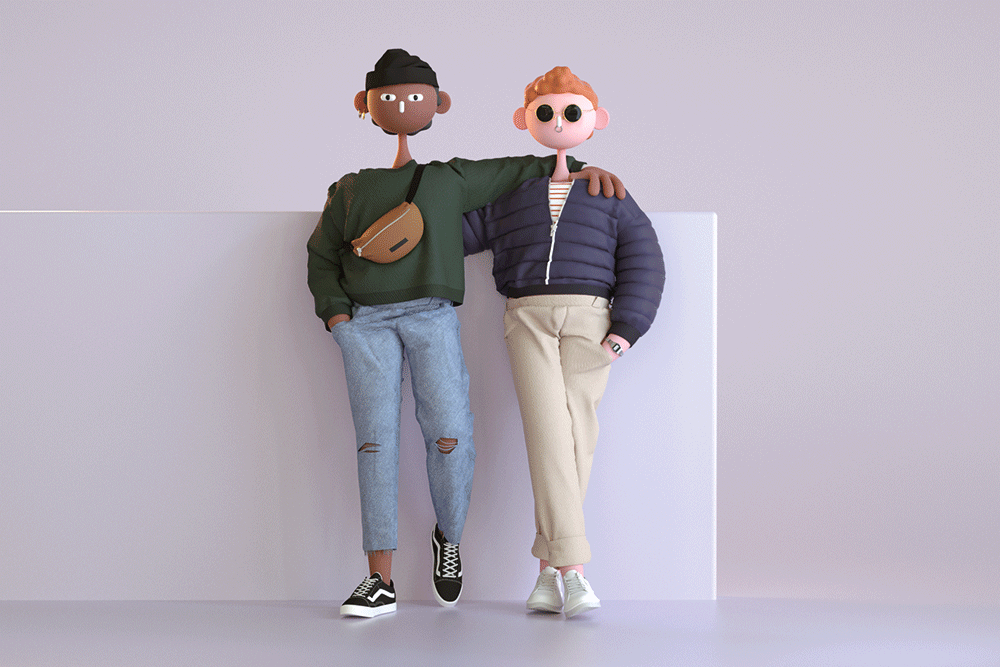
The physiognomy of your characters is very similar. None have eyebrows or a mouth, but all have a head round as a ball and half-moon shape ears . . .
Abel: We didn’t realize how important it is to us to stick with this until recently when we had a job with a client who wanted to change a little bit about them, and we had to say no. Of course, it would be interesting to develop new characters in the future. But for now, we think the proportions work really well and there is something very enjoyable and beautiful about the repetition.
Katie: Apart from this, it is also quite complicated to make a really simple and good graphical character. I think people misunderstand that often. They think simple is easy, but it’s the other way around. So when we found something that is working so beautifully we wanted to keep the essence and make the rest different every time.
Even with your characters being so abstract, they are closely linked to the now, they’re stylish and represent a very current attitude towards life. Are you also some sort of psychologists observing human behavior and translating it into your character design?
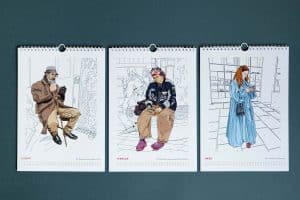
Katie: I think so. Sometimes it’s personality or behavior that characterizes our characters, sometimes the inspiration might come from somebody’s clothing or hairstyle. It can happen that we see someone in the street wearing a fabulous coat and then we make a character that is based on it. Or we see somebody painting a window in a fun position and start from there.
Abel: Even though we don’t buy too many clothes, we both like fashion. We’re spending most of our time in Barcelona or London where you see people dressing in a lot of different ways and we like to observe that. But we also really enjoy to go to museums to explore the positions in classical paintings. They are very interesting.
Do you have some favorites?
Abel: We really like the work of Alexander Calder. Because we work in 3D it’s very interesting for us to see how he constructed his characters and sculptures.
Katie: At the Whitney Museum in New York, we saw the Cirque Calder he made in 1931. It’s a whole circus made out of wires, corks, cloths and many other materials. We stayed in this exhibition room for hours fascinated by his ability to create characters. The longer you are doing this work, the more sophisticated it gets. But the essence in his work also remains the same, it’s still very playful and like a child’s fantasy.
How do the dog characters fit into your world? Are they animals, humans or a new species?
Abel: We both are deep admirers of Wes Anderson, his work was one of the main inspirations for the dogs. We really like how his animals become humanoid.
Katie: Yeah, they often have very defined personalities and I find that hilarious. We both really like dogs and definitely think of our dog characters as personae that live alongside humans. They are clever, emotional intelligent, have dignity and they know what’s going on.
Abel: They are more the cool type with fancy clothes. But we did another series after we were in South Korea last year, just before the lockdown started. The very cute type of dogs they have there inspired us.
Katie: And also, the humor of the Asian TV shows we watched there. It is based in situations that are serious and absurd at the same time and we tried to translate that into our new dog series. That wasn’t easy, but a really nice challenge.


How do you work together when you are making a character?
Abel: Katie is doing the sketching and all the clothing, and I usually do the 3D modeling and the lighting in Cinema 4D with OctaneRender. We work separately on it and at the end we adjust everything together. But since we’re a couple and also live together, it’s a constant discussion anyway.
Katie: We stick to the skills we both come from. I always enjoyed making my own clothes. And to translate this onto our characters is quite funny because they have such strange proportions. I really like to play with it. Without the head and the realistic clothes they wouldn’t be Cabeza Patata characters.
Are you a seamstress?
Katie: I never learned it formally. But as a child my mum showed me how to make patterns, and I started to make clothes for my toys on my grandma’s sewing machine. When I got older, I started to make clothes for myself and I still do it today. I’m sewing many of my dresses, shirts and trousers myself. I also print patterns now and I create some of the clothing for the characters not only in 3D but also in real life for fun.
Ever thought of matching clothes for you and your characters?
Katie: (laughs) No, I haven’t thought of this before. But it’s a really fun idea.
And how are you making the 3D clothes?
Katie: We use the program Marvelous Designer that is actually for fashion design. You have a split screen and on one side you build the pattern and on the other you have a digital sewing machine. So you can make the clothes on the screen like you would be doing it in real life. You even have pins, yarns and an iron.

I think fashion was also a crucial part of the character you created for Spotify. That it is gender-neutral sounds like a real challenge.
Katie: Yes, it was. The briefing said to create a gender-neutral character with no specific age or race so that it is really appealing to everyone. But during our job we realized that it’s not possible to represent everybody in one character. Trying it you end up going toward clichés that you are hoping to avoid anyway. When we created an angry character for example everybody was seeing a man in this, because we’re just not used to allow women to be angry. It was very difficult to get around that. On the other hand, the character couldn’t have big hips, breasts, long hair or wear a dress because it would be too obviously a woman. At the end we had to tend towards male characteristics as we do in society anyway, more androgynous, with long limbs and flat-chested. That was a setback for us.
Abel:
There is nothing wrong with gender-neutral characters, but for us they are not the solution. We think variety is much better to represent everyone, to have as many diverse characters as possible. Since then, we’re not only trying to break down clichés and stereotypes in our work, but also to push this with every client.
Is that one of the reasons you said that characters, fashion, and politics are the three biggest parts of your work? Do you see your work as political?
Katie: Definitely. Since the beginning it’s been political. We both are. Even more so since we finished the Spotify project. Not to mention how male dominated the industry is. Because of that you see a lot of the same type of work, a lot of the same characters, of the same voices promoted. From the beginning, we were very conscious about the political impact of our work and wanted to do something different. And it’s not very hard either. As soon as you switch that flip in your head and for example make more female characters instead, you already do something different.
Do you think that when your work is shown all over cities, for example, that this comes with a special responsibility? Also because something visual has probably a bigger impact than something theoretical?
Katie: Absolutely. We’re painting a lot of murals as well and this is also something very male dominated. But I think it even has an effect seeing a woman painting in the street. But especially when we have posters and ad campaigns all around the city, we’re always challenging the clients to allow us to do at least a slightly different spin on it. I think it does have a big impact.
Abel: Especially when you grow up, the books you are reading, the illustrations you are seeing or the cartoons you are watching are building your reality and the role patterns that form you. So as illustrators we have a huge responsibility to shape the world.
Katie: And we’re just talking about gender here. But what’s about race or the promotion of disability in advertising? It’s still so small and we’re in a position to push it and to show diversity. People often don’t realize their own power and ending up saying yes to everything.
Abel: Also when it comes to themselves. We work a lot in Europe and in the USA and it happens that companies expect that people work for free. That’s so outrageous and we are trying to fight this. With more clients and a little more power we think it’s our responsibility. We don’t do free pitches, we don’t work late or on weekends.
Katie: A lot of people think they have to be so lucky that a huge company wants them for the job. But this is just how the industry is structured. It wants you to feel that rather than to see your own ability.

As freelancers you really don’t work on evenings or weekends?
Katie: No, we really don’t.
And there are also a lot of clients you won’t work for.
Abel: Yes, we say no a lot. For example, we definitely wouldn’t work for anything related to betting. All that online gambling that grew so much during the pandemic is a horrible business built on people’s desperation. We really think twice about who we are working with. But we totally understand that not everybody has this freedom.
Katie: For us it’s also very important that if we say no to the jobs that we morally don’t agree with, we don’t do it aggressively. We’re not on a high horse and we’re not fighting the agency or the client. Instead, we’re inviting them for a discussion on what we are thinking. For us it’s the best way to make change. Not by being combative so that the other feels bad or defensive, but by talking about it.
Abel: That also applies to the conditions. We don’t want to agree to something that seems unfair. Like when clients want to get rights for images forever. We claim the right to ask them why they need them even if they only want to use them for a year. It is very important to have these conversations.
Katie: You have to make people know your value. And you have to do it from the beginning otherwise you get overworked. Often people say that they got a new job and are staying late to make a good impression. And I think ‘oh no’, it’s crucial that you leave early the first day.
Is being in a friendly conversation also what you do in huge campaigns like for the Museums-Quartier that showed diverse characters in a completely unagitated way all over Vienna?
Abel: Sometimes our work can be political without being very obvious. It’s always friendly and we think that is a good approach to get in touch with people. It is important to us to be open and to create conversations instead of pushing people into a defensive position.
Katie: Sometimes people see our friendly characters and think we’re naive. That annoys us a lot, because we’re furious about the politics in the world and we have a lot of struggles and fights with clients to come up with special characters. Because we believe that there is a big subliminal effect in seeing images that are different.


You also published a statement that you morally reject crypto art and won’t be taking part in it. Why did you get official and what were the reactions?
Abel: It is undeniable that crypto currency and therefore also crypto art has a huge environmental impact. Therefore, we were surprised that so many people jumped into it. We had the feeling that many of them don’t really know what they are doing, that a bubble is being created and only a very small group of people is making a lot of money from it.
Katie: At the beginning a lot of people tried to convince us to join. We thought it’s quite a strange choice for a sustainable business and started to read about crypto currency and crypto art in general. After that we decided to make a statement to inform and also to warn people to invest a lot of money putting their work on a platform.
Abel: We thought it will have some repercussion because we have a lot of followers on Instagram. But we haven’t expected that it would explode like that. We got hundreds of messages. Most of them were very positive, but of course we also got negative comments. For us, the general problem is that there are so many illustrators that are not making enough money even though big companies are earning a lot with the help of their work. This is very unfair. But for us, the solution is not to feed the unfair system even more. There are very powerful platforms behind crypto art and their commissions are unbelievable. Sometimes they take more than 30 percent of the buying price. You cannot compare this with galleries or the art world because crypto art is all online and the mechanisms are very opaque. Don’t get us wrong, we’re not against making money, but we think what we really need is a better work environment for everybody. Illustrators should earn more money, have time to relax, do personal work, buy houses and raise families. That’s what we believe in and that’s what we are fighting for.
This interview was published in PAGE 09.2021. The complete issue is available for download here.