Wir sprachen mit Duncan Clark, Head of Canva EMEA, über die Bedeutung von Affinity im Canva-Ökosystem, den Versuch, Design zu demokratisieren und die Rolle von Design in Zeiten von KI
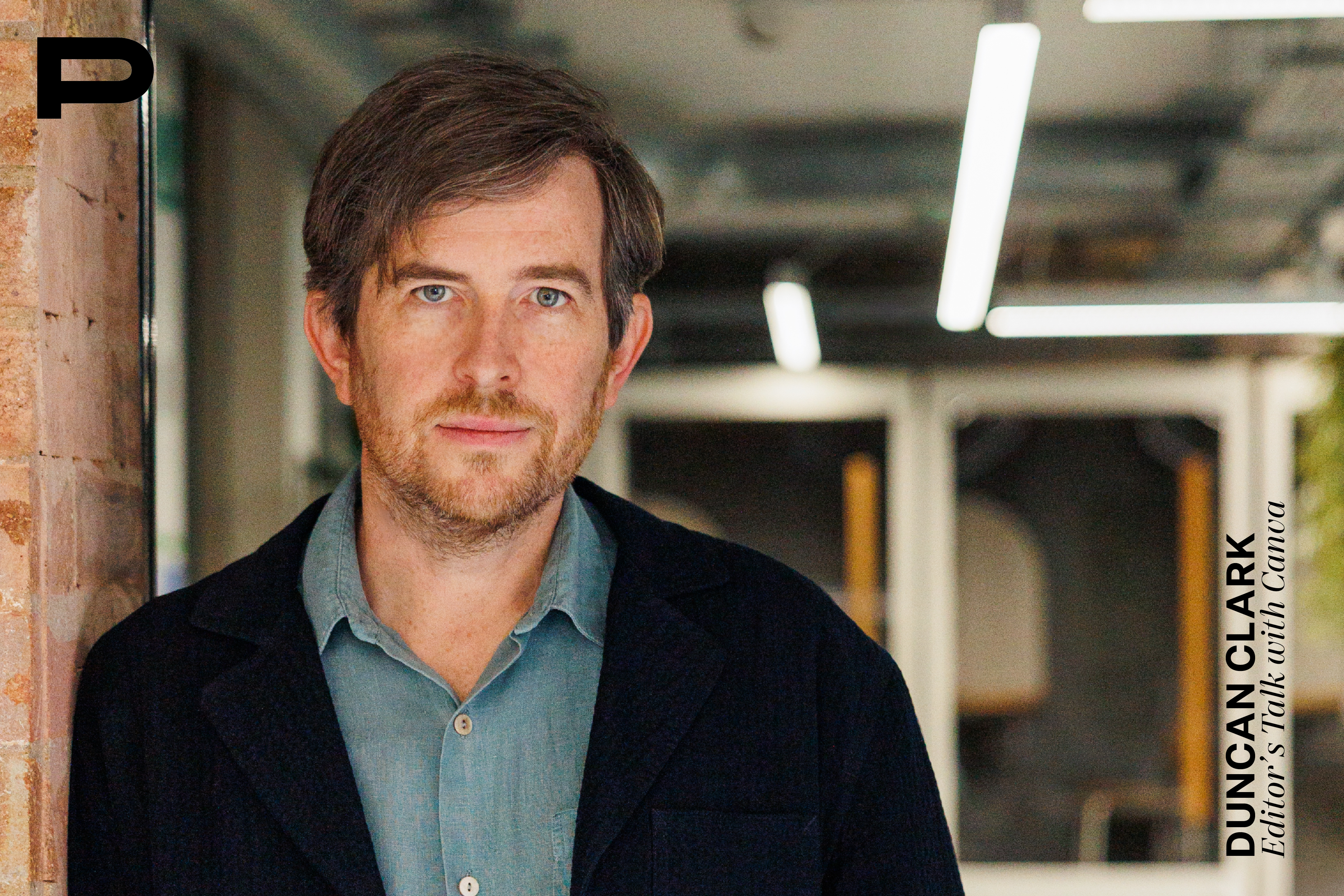 Bild: Amber Pollack Photography
Nur wenige Tage nach dem Launch der neuen Affinity App haben wir Duncan Clark, Head of Canva EMEA, in unserem Münchner Büro auf Kaffee, Brezen und ein Gespräch über die Zukunft des Designs getroffen. Canva wagt einen mutigen Schritt und stellt Affinity »free forever« zur Verfügung – inklusive Desktop-App und allen zukünftigen Updates. Diese Entscheidung sorgte in der professionellen Design-Community für Furore. Duncan spricht über die Hintergründe dieser Aktion, Canvas Positionierung in der Designbranche und seine Sicht auf KI als Werkzeug zur Skalierung von Designprozessen.
Im Interview sprechen wir über:
+ Umdenken in der Architektur von Designwerkzeugen
+ Mission: Design demokratisieren
+ Nutzergetriebene Entwicklung
+ Das Creative Operating System
+ Designhandwerk im Zeitalter der KI
Die Architektur von Design-Tools neu gedacht
Anne: Affinity by Canva ist erst seit wenigen Tagen auf dem Markt, und verzeichnen bereits ein rasantes Nutzerwachstum. Wie viele dieser Nutzer:innen sind professionelle Kreative, die Affinity aktuell testen? Und was kannst du uns über deren Hintergrund erzählen?
Duncan: Wir haben in den ersten zwei Wochen zwei Millionen Registrierungen verzeichnet – eine Million allein in den ersten vier Tagen. Es gab also einen unglaublichen Ansturm. Aber es sind nicht nur professionelle Kreative, sondern vielmehr fortgeschrittene Designer:innen aller Art, die in das Canva-Ökosystem einsteigen. Das ist wirklich spannend.
Unsere Kernnutzerbasis ist natürlich riesig: 260 Millionen monatlich aktive Nutzer:innen. In manchen Ländern nutzt bereits jede fünfte Internetnutzer:in Canva monatlich. Der potenzielle Markt für Nicht-Expert:innen ist also deutlich größer. Das Expert:innensegment sehen wir aber als absolut strategisch zentral für die gesamte Designwelt von Canva.
Europa ist einer unserer am stärksten durchdrungenen Märkte. In Spanien etwa verwendet jede siebte Internetnutzer:in Canva monatlich. Deutschland zählt zu den am schnellsten wachsenden Märkten weltweit und gewinnt rasant an Bedeutung. Auch Affinity ist in Westeuropa extrem präsent und führt seit seinem Start die Downloadzahlen an.
Anne: Du warst ja selbst schon immer kreativ, mit deinem journalistischen Hintergrund (The Guardian) und deiner eigenen Firma für Datenvisualisierung, die heute auch Teil des Canva-Ökosystems ist. Wie würdest du professionelle Kreative davon überzeugen, Affinity auszuprobieren, selbst wenn sie schon lange andere Tools nutzen?
Es gibt mehrere Gründe. Besonders spannend ist die neue Benutzeroberfläche von Affinity, die die Arbeitsweise solcher Tools grundlegend neu denkt. Affinity vereint einen professionellen Fotoeditor, einen professionellen Vektorgrafikeditor und ein professionelles Seitenlayout-Tool in einer einzigen Arbeitsfläche. Dieser Editor ermöglicht einen nahtlosen Wechsel zwischen den verschiedenen Disziplinen, ohne dass man das Tool wechseln muss.
Sobald man es einmal ausprobiert hast, kann man sich kaum mehr vorstellen, dass man vorher mit separaten Tools gearbeitet hat. Jetzt kannst du in einer einzigen Benutzeroberfläche arbeiten, und alle deine Dokumenttypen lassen sich in einem einzigen universellen Dateiformat speichern. Das ist ein echter Durchbruch für fortgeschrittene Designer:innen.
Ein weiterer Punkt ist die Performance. Affinity ist unglaublich leistungsstark. Du kannst detailreiche Vektorgrafiken bis zu 10 Millionen Prozent vergrößern, ohne dass die Rendergeschwindigkeit leidet. Du arbeitest in Echtzeit mit fortschrittlichen Filtern und siehst die Effekte sofort, ohne das Original zu verlieren.
Und die Art und Weise, wie Affinity mit Canva zusammenarbeitet. Du gestaltest in Affinity und skalierst in Canva. Du kannst Markenmaterialien, Logos, Vektorillustrationen – alles, was du als Expert:in brauchst – erstellen, mit einem Klick in Canva hochladen und in einem Tool bereitstellen, wo sie jede:r nutzen kann.
Canva selbst hat stark in die unternehmensweite Skalierung einer Marke investiert. Es gibt Vorlagen mit gesperrten Elementen, sodass Nutzer:innen die Markenrichtlinien problemlos einhalten können. Wir sehen das als umfassende Lösung: Professionelle Designer:innen werden befähigt, ihre Kolleg:innen in die Lage zu versetzen, eine Marke optimal zu nutzen.
Anne: … und um besser zusammenzuarbeiten. Denn das Marketingteam dazu zu bringen, die Markenrichtlinien einzuhalten, ist eine Herausforderung für sich.
Absolut. Ich habe gestern auf einer Veranstaltung gesprochen, und dabei fiel der Satz: »Von der Brand Police zum Brand Enabler werden«. Affinity und Canva sind genau die Kombination von Tools, um das zu erreichen.
Mission: Design demokratisieren
Stefan: Bevor wir uns näher mit dem Tool befassen, noch eine Frage zu den Kosten. Affinity ist »free forever« – wie bereits in der Kampagne angekündigt. Mit Blick auf die Zukunft: Glaubst du, dass dieses Geschäftsmodell auch in fünf Jahren noch Bestand haben wird?
Ja, wir stehen voll und ganz dahinter. Beim Launch haben wir bewusst »free forever« gesagt und nicht nur »free«. Sonst hätten viele gedacht, es handele sich um ein Einführungsangebot, das ist es aber nicht.
Wir sind überzeugt, dass eine herunterladbare Desktop-Anwendung, deren Kosten für neue Nutzer:innen minimal sind – eine großartige Chance bietet, unsere Mission zu verwirklichen: Design nicht nur für Anfänger:innen, sondern auch für Profis zu demokratisieren. Natürlich gibt es auch einen kommerziellen Nutzen. Mit unserem Creative Operating System haben wir eine umfassende Plattform für visuelle Kommunikation. Das ist eine enorme Chance für Canva. Und wir sind überzeugt, dass wir durch die kostenlose Bereitstellung dieses neuen Tools letztlich mehr Nutzer:innen gewinnen – darunter auch solche, die für Erweiterungen wie Canva AI bezahlen möchten.
»Wir möchten, dass die Menschen verstehen, dass wir wirklich eine Demokratisierung des Designs anstreben und dies nicht nur aus kommerziellen Gründen behaupten.«
Unsere Philosophie bei Canva war schon immer – und das ist absolut zentral für unser Wachstum –, dass wir ein wirklich gutes, wertvolles Gratisprodukt anbieten sollten. Das ist nicht nur für die Akzeptanz wichtig, sondern auch für das Markenverständnis. Wir möchten, dass die Menschen verstehen, dass wir Design wirklich demokratisieren wollen und das nicht nur aus kommerziellen Gründen behaupten.
Diese Philosophie haben wir nun auch auf Affinity übertragen, wo wir das Basis Desktop-Tool kostenlos anbieten. Es gibt dafür keinen Grund, aber indem wir es kostenlos anbieten, schaffen wir die Sicherheit, dass jede:r die Datei jederzeit öffnen kann. In Gesprächen mit professionellen Designer:innen stellten wir fest, dass viele mit bestehenden Tools unzufrieden sind. Neben überhöhten Preisen war ein häufiger Kritikpunkt, dass sie sich an Dateiformate gebunden fühlten, die man nur mit einem laufenden Abonnement öffnen konnte.
Und das widerspricht unserem Verständnis von einem offenen Zugang sehr. Wir finden es spannend, wenn man an das globale Potenzial von erfahrenen Designer:innen und neuen Kreativen denkt. Gerade in einkommensschwachen Ländern oder unter Schüler:innen gibt es viele, die das Handwerk des professionellen Designs erlernen könnten und sollten, aber sie können es sich aufgrund der hohen Kosten nicht leisten – und das ist ein vermeidbares Problem.
Nutzergetriebene Produktentwicklung
Anne: Der Softwaremarkt entwickelt sich rasant. Große Player und Newcomer bringen ständig neue Tools auf den Markt. Gibt es etwas, das ihr bei Affinity bewusst nicht macht, nur weil es andere tun?
Das mag sich wie eine einstudierte Antwort anhören, aber wir machen uns wirklich nicht viele Gedanken über Wettbewerber. Wir konzentrieren uns voll auf unsere Kund:innen und Nutzer:innen und hören ihnen sehr aufmerksam zu. Bei Canva haben wir ein Programm namens »Close the Loop«, in dem jeder einzelne Funktionswunsch erfasst wird. Und selbst wenn es zwei Jahre dauert, bis wir die Funktion veröffentlichen, wenden wir uns an die Person, die sie angefordert hat. Es geht darum, sich bewusst zu machen, dass ihr Feedback die Grundlage für zukünftige Produktentwicklung bildet. Affinity ist eine logische Weiterentwicklung davon. Indem wir der professionellen Design-Community und ihren gemeinsamen Problemen zuhörten, konnten wir Affinity optimal in diesem Bereich etablieren.
Stefan: Diese Antwort könnte auch ein Mitbewerber geben. Aber im Grunde vertreten wir bei PAGE dieselben Ansichten. Unsere Aufgabe ist es, alle Marktentwicklungen zu beobachten und aufzuzeigen, was die Community wirklich will. Das ist unsere Mission.
Anne: Außerdem sind wir unglaublich neugierig. Also kannst du sicher sein, dass wir Affinity ausprobieren werden. Diese Art von Neugier möchten wir auch in unsere Community einbringen. Wenn ich einen Vorschlag machen darf: Wenn ihr Affinity wirklich für kreative Einsteiger:innen positionieren wollt, solltet ihr mit verschiedenen Designhochschulen zusammenarbeiten. So könntet ihr ein Designstudium zugänglicher und erschwinglicher machen.
Wir freuen uns sehr über das Potenzial von Affinity als Standardwerkzeug für Studierende, die erste Erfahrungen im Grafikdesign sammeln. Wir arbeiten bereits mit Partnern wie Creative Lives in Progress in London zusammen, um Nachwuchsdesigner:innen zu unterstützen.
Anne: Ich denke, es könnte auch einen Generationswechsel geben, wenn jemand, der mit Affinity angefangen hat, in eine Branche wechselt, die andere Design-Tools verwendet.
Wir beobachten bereits etwas sehr Ähnliches bei Canva-Präsentationen. Viele haben Canva an der Universität oder in der Schule genutzt. Jetzt, wo sie ins Berufsleben eintreten, bestehen sie darauf, Canva weiterhin einzusetzen. Deshalb sehen wir diese enorme Verbreitung von unten nach oben in nahezu allen großen Unternehmen weltweit.
Das Creative Operating System
Anne: Wir möchten bei PAGE dem Wert von Design mehr Sichtbarkeit verschaffen. Damit geht eine neue Zielgruppe einher, denn in den Unternehmen sitzen die Entscheidungsträger:innen für Design oft in Marketing oder Strategie und fühlen sich mit Canva natürlicherweise wohler. Also könnte die Integration von Affinity in Canva dazu beitragen, Design hier stärker sichtbar zu machen. Wie könnte Affinity den Arbeitsalltag von Kreativen im Unternehmen verändern? Und was steckt hinter dem Creative Operating System?
Ich fange mit dem Creative Operating System an: Canva basiert auf dem, was wir die »Canva Design Engine« nennen. Das ist die Plattform, die allem zugrunde liegt, sie war bereits Teil unseres ursprünglichen Canva-Systems vor 15 Jahren. Darauf haben wir eine Vielzahl von Anwendungen aufgebaut, von Videopräsentationen über Social Media bis hin zu Printprodukten.
Nun, da wir die KI-Ebene durchgängig in unsere Produkte integriert haben, ist die Bezeichnung Creative Operating System durchaus gerechtfertigt. Wir sind keine Neulinge im Bereich KI. Vor vier bis fünf Jahren haben wir Kaleido, das führende Unternehmen für visuelle KI aus Wien, übernommen und setzen KI schon lange auf unterschiedliche Weise in unseren Produkten ein.
Seit dem rasanten Wachstum großer Sprachmodelle hat sich die Entwicklung enorm beschleunigt. Wir haben Magic Studio vor einigen Jahren eingeführt, und seitdem wurden unsere KI-Funktionen 22 Milliarden Mal genutzt. Das Spektrum reicht von der Hintergrundentfernung bis zur Übersetzung von Präsentationsunterlagen in verschiedene Sprachen.
»Immer mehr Bereiche in Organisation produzieren mehr visuelle Inhalte.«
Man kann es sich also als dreischichtiges System vorstellen: die Basisplattform, das KI-gestützte Level und die nutzerorientierten Anwendungen. KI ist für uns lediglich ein Weg, unsere Ziele innerhalb dieses Systems zu erreichen. Es geht darum, Nutzer:innen schneller zu ihren Ergebnissen zu verhelfen, höhere Qualitätsstandards zu setzen und Engpässe zu beseitigen.
Um auf deine Frage zurückzukommen: Innerhalb eines Arbeitsablaufs könnte beispielsweise ein:e CMO damit zu kämpfen haben, dass die Erwartungen in unserer heutigen, stark visuell geprägten Welt immer weiter steigen. Es gibt mehr Inhalte, mehr Formate, mehr Plattformen, mehr Sprachen und mehr Zielgruppen. Immer mehr Bereiche des Unternehmens produzieren visuelle Inhalte. Nicht nur die Marketingabteilung, sondern auch die Personalabteilung, der Vertrieb und die Rechtsabteilung. Und es fällt Marketingteams schwer, mitzuhalten, obwohl längst allen klar ist: Ohne visuelle Kommunikation ist Kommunikation wirkungslos.
Wir haben uns Mühe gegeben, ein Tool zu entwickeln, mit dem Unternehmen das Potenzial visueller Kommunikation voll ausschöpfen und gleichzeitig ihre Markenidentität wahren können. Affinity ermöglicht genau das, denn hier kannst du einzelne Elemente präzise anpassen, Logos erstellen und mit erweiterten typografischen Funktionen arbeiten – und diese dann direkt in die Plattform integrieren, auf der alle Mitarbeiter im Unternehmen ihre Arbeit erledigen.
Anne: Affinity als Teil von Canva könnte also auch professionellen Kreativen helfen, wieder stärker in Entscheidungsprozesse eingebunden zu werden.
Absolut! Wir haben gerade unseren Brand Hub aktualisiert, mit dem du Brand Guidelines, die normalerweise von einem Designer oder einer Designerin erstellt werden, direkt in den Editor einbinden kannst, in dem alle ihre Arbeit erstellen.
Wir kennen alle das Problem: Brand Guidelines liegen als PDF irgendwo in einem Dropbox-Ordner, jeder weiß, dass es sie gibt – aber niemand hat Zeit, sich damit auseinanderzusetzen, wenn man gerade schnell die Präsentation für den großen Pitch zusammenstellen muss. Wir glauben, dass es ein echter Durchbruch für die Markenkonsistenz ist, wenn die Brand Guidelines als interaktiver, sichtbarer Bestandteil direkt in dem Tool verankert sind, das täglich zur Erstellung visueller Inhalte genutzt wird.
Designhandwerk im Zeitalter der KI
Stefan: All diese Möglichkeiten erlauben es also auch Nicht-Designer:innen, mehr selbst zu gestalten. Bedeutet das, dass wir keine Full-Service-Agenturen mehr brauchen? Glaubst du, dass Designspezialist:innen auch in Zukunft noch relevant sind?
Wir sind große Verfechter von Expertise und handwerklicher Qualität. Wir glauben, dass der Bedarf an hochqualifizierten Designer:innen, an echten Expert:innen, die originelle, ansprechende und kreative Arbeiten schaffen können, größer ist denn je. Unsere Entscheidung, Affinity nicht nur zu übernehmen, sondern es auch kostenlos anzubieten, unterstreicht unser Engagement für professionelle Designer. Denn wir glauben, dass der rasante Aufstieg von KI die Zahl der am Designprozess Beteiligten erhöht. Und je mehr Menschen beteiligt sind, desto wichtiger werden Markenarchitekt:innen, Markenspezialist:innen als Kurator:innen und Optimierer:innen sowie menschliche Redakteur:innen.
Manchmal wird mir die Frage gestellt, ob weniger Menschen im Designbereich tätig sein werden, wenn Canva und KI es vereinfachen. Ich verweise dann einfach auf unsere Nutzer:innenzahlen. Die steigen seit 15 Jahren exponentiell. Es gibt also nicht nur mehr Designer als je zuvor, sondern auch mehr professionelle Designer:innen als je zuvor.
Anne: Ich glaube, wir sind an einem Punkt, an dem wir auch darüber sprechen müssen, was Design eigentlich ist. Ich finde es toll, dass du das Wort »Handwerk« verwendet hast, denn genau das versuchen wir als PAGE wieder stärker in unsere Kommunikation einzubringen. Design ist viel mehr als schnelle und effiziente Erstellung von Assets; es geht um Expertise und die besondere Leidenschaft, die dahintersteckt. Genau das unterscheidet uns von KI. Was hältst du von KI und wie ist sie in Affinity integriert?
Wir verfolgen einen dreigleisigen Ansatz im Bereich KI. Wir entwickeln eigene KI-Modelle und betreiben eigene Forschung in Bereichen, in denen wir uns vom Markt abheben. Zudem integrieren wir Modelle und Tools von Drittanbietern, um unsere Nutzer:innen optimal zu unterstützen. Darüber hinaus bieten wir unsere Ökosystem-Plattform an, die es externen Entwicklern und Unternehmen ermöglicht, neue Funktionen mithilfe von Apps und APIs in Canva zu integrieren. Viele dieser Funktionen basieren auf KI.
Wir gehen also bewusst mit KI um, die wir als grundlegendes Werkzeug für das nächste Jahrzehnt in allen drei Bereichen sehen. Wir haben kürzlich unser eigenes Basismodell veröffentlicht, da wir ein Problem mit herkömmlichen visuellen KI-Modellen erkannt haben: Sie erzeugen flache Bilder. Text lässt sich zwar integrieren, aber nur auf Pixelbasis. Das ist kein Design, sondern reine Bildgenerierung. Wir sind überzeugt, dass der eigentliche Designaspekt in der Kombination von Komponenten wie Typografie, Farbe und Komposition liegt.
Wir haben uns also zum Ziel gesetzt, ein Modell für Design statt für Bildgenerierung zu entwickeln. Dieses haben wir erst vor wenigen Wochen veröffentlicht. Es funktioniert so: Das Modell wurde mit unserer großen Template-Bibliothek trainiert, die von Kreativen erstellt wird, die mit der Erstellung von Templates Geld verdienen. Um es klarzustellen: Wir haben bewusst darauf geachtet, dass sie für die Nutzung ihrer Templates im Training Lizenzgebühren erhalten. Die Teilnahme ist freiwillig. Das Modell wird außerdem nicht mit Benutzerdesigns trainiert.
Das ist der perfekte Datensatz, um der KI beizubringen, was ein gutes Layout ausmacht: Wie werden Elemente auf einer Seite angeordnet – nicht als Bild, sondern als vollständige Konfiguration von Designelementen. Das ist unser wesentlicher Beitrag. Und weil das Ergebnis ein vollständig editierbares Canva-Design ist, gibt es keine Sackgasse mehr. Man erhält einen Ausgangspunkt zum Bearbeiten, vollständig markenkonform.
Anne: Da KI immer leistungsfähiger wird, werden viele diese editierbaren, generierten Designs als fertiges Produkt betrachten. Wie können wir professionelles Design im Jahr 2026 relevant halten?
Design und visuelle Kommunikation verstehe ich so, dass wir im Grunde visuelle Wesen sind. Unser Gehirn ist auf visuelle Reize ausgelegt. Wir reagieren auf Farben und Bewegung auf einer sehr instinktiven Ebene. Und im Laufe des letzten Jahrhunderts hat die Technologie nach und nach aufgeholt.
Anfangs bestand die Kommunikation also aus schwarz-weißem, gedrucktem Text. Mehr war mit der damaligen Technologie nicht möglich. Seit dem Aufkommen von Desktop-Publishing, dann Social Media und schließlich zugänglichen Tools wie Canva beobachten wir jedoch eine steigende Erwartungshaltung, dass alles visuell sein muss.
»Es ist eine visuelle Welt und Design ist alles.«
Wir leben heute in einer visuellen Ökonomie, einer visuellen Welt, in der Design alles ist. Es gibt keinen visuellen Content ohne Design! Und die Messlatte steigt. Alles wird visueller, und immer mehr Menschen beteiligen sich aktiv am Gestalten.
Wir glauben, dass Design zur treibenden Kraft wird und dabei die Arbeitswelt neu strukturiert. Unsere Interaktion mit der Welt ist heute grundlegend visuell geprägt. Je mehr Menschen mit Gestaltung zu tun haben, desto wichtiger wird Design. Und dieser Trend wird sich fortsetzen.
Anne: Welche Fähigkeiten würdest du einem jungen Kreativen für 2026 empfehlen?
Ich denke, Kreative, die 2026 ihre Karriere beginnen, sollten sich nicht nur auf handwerklich hochwertige Inhalte konzentrieren, sondern diese Fähigkeit mit echter Kreativität und Ideenfindung verbinden. Wir leben in einer Aufmerksamkeits- und gleichzeitig einer Designökonomie. Es finden diejenigen ihren Platz in Unternehmen, die nicht nur qualitativ hochwertig arbeiten, sondern auch herausragende Ideen entwickeln. Ideen, die in einer Welt, in der immer mehr visuelle Inhalte produziert werden, aus der Masse herausstechen.
Außerdem muss man lernen, die eigene Arbeit zu skalieren. Wer schon früh versteht, dass es nicht nur darum geht, schöne Assets zu gestalten, sondern diese für unterschiedliche Märkte, Sprachen, Zielgruppen und Plattformen einzusetzen, wird gefragt sein.
Stefan: Letzte Frage: Wie schätzt du als Head of Canva EMEA dein Business in den nächsten fünf Jahren ein?
Wenn ich die nächsten fünf Jahre betrachte, sehe ich ein enormes Potenzial, Design und visuelle Kommunikation für die meisten Menschen weltweit zugänglich zu machen, die noch immer mit veralteten Tools arbeiten. Gleichzeitig bietet sich die Chance, viel Gutes zu bewirken. Canva beispielsweise hat einen erheblichen Teil seiner Anteile für wohltätige Zwecke gespendet.
Wenn wir der Welt durch unsere Tools einen Mehrwert bieten, streben wir danach, Wert zu schaffen, den wir auf anderen Wegen zurückgeben. Wir haben gerade 100 Millionen Dollar an GiveDirectly gespendet, um die Bekämpfung extremer Armut zu unterstützen und innovative Lösungen zu entwickeln.
Ich möchte, dass wir das große Ganze betrachten und uns fragen, welchen guten Beitrag wir leisten können, indem die Menschen unsere Werkzeuge nutzen und wir dabei helfen, einen Unterschied in der Welt zu bewirken.
Über Duncan Clark
Duncan Clark leitet das Europageschäft von Canva. Er kam als Mitgründer von Flourish, einer Plattform für Datenvisualisierung, die 2022 Teil der Canva-Familie wurde, zu Canva. Er arbeitet am europäischen Hauptsitz des Unternehmens in London und verantwortet Canva in der EMEA-Region mit besonderem Fokus auf Datenvisualisierungsprodukte.
Vor der Gründung von Flourish war Duncan als Datenjournalist beim Guardian tätig und konzentrierte sich auf Klimawandel, Datenvisualisierung und interaktives Storytelling. Sein tiefes Interesse am Klimawandel führte ihn zur Co-Autorenschaft von „The Burning Question“ – einer datenbasierten Analyse, die den Klimawandel als das faszinierendste wissenschaftliche, politische und soziale Rätsel der Geschichte darstellt.
Canva Design Trends 2026
Canva analysiert, was bei den Nutzer:innen hoch im Kurs steht. Daraus destilliert Canva sieben Trends, die Marken 2026 kennen müssen – unsere Schwester W&V erläutert, was sie für eure Kommunikationsstrategie bedeuten.
Hier geht es zum Artikel
PAGE Editor´s Talk with Canva: »We believe that design is the new language of work«
Canva acquired Affinity and went fully free forever. We talked to Duncan Clark, Head of Canva EMEA about the implications for creatives and Canva´s vision for a design industry that is not shaped, but empowered by AI
Only a few days after Canva announced their partnership with design software company Affinity, we met Duncan Clark, Head of Canva EMEA at our Munich office for coffee, pretzels and a chat about the future of design. In a bold move, Canva opted to make Affinity free forever, including a desktop app and all future updates for the tool – which went viral throughout the professional design community. We asked Duncan about the intention behind the launch, Canva´s positioning within the professional design industry and how he views AI as a tool to help scale the design process.
In this interview, we talk about:
+ A Rethink of Design Tool Architecture
+ On a mission to democratize Design
+ User-Driven Development
+ The Creative Operating System
+ Craft in the Age of AI
Anne: It’s been just a few days since the launch of Affinity by Canva and we’re seeing rapid user growth. How many of those are professional creatives, now testing out Affinity? And what can you tell us about their background?
Duncan: We have had 2 million registrations of the new Affinity product in the first two weeks and we had a million of those in the first four days. So it’s been an amazing rush of new users. But I wouldn’t say it´s only professional creatives, but rather all kinds of advanced designers coming into the Canva ecosystem, which is really exciting.
Obviously our core user base is vast. We have 260 million monthly active users and we are at the point where in some countries one in five Internet users use Canva every single month. So the addressable market is much bigger for non-experts. But we see the expert segment as absolutely strategically central to the whole design world within Canva.
Europe has some of our most penetrated markets. For example, in Spain, we’re at 1 in 7 Internet users who use Canva every month. Germany is one of the fastest growing markets in the world and quickly becoming a bigger part of our business. And we can also see an extremely strong presence for the Affinity product in Western Europe, which has been leading the charge for downloads since we launched in the last two weeks.
Anne: You have always been a creative yourself, with your background in journalism (The Guardian) and your own firm for data visualization that is also part of Canva´s ecosystem today. How would you convince professional creatives to try out Affinity, even if they have been using other tools for a long time?
I think there are several reasons why all professional designers should try Affinity. The thing that’s most exciting about it is that the new Affinity interface is the first major rethink for how these types of tools work architecturally. What Affinity has done is, it´s pulled together a professional grade photo editor, professional grade vector editor and a professional grade page layout tool into a single canvas. A single editor, which allows you to move seamlessly between the different disciplines without having to change tools.
Once you’ve tried this – and I promise you, because I’ve been on this journey in the last couple of months with the beta product – it’s very strange to look back and think that you had separate tools. Now you can work within one interface and all of your document types work within a single universal file format, which is really game-changing for advanced designers. That´s something that is very philosophically aligned with what we’ve done at Canva, where you can seamlessly move between a video presentation and a whiteboard.
Another reason is performance. Affinity has built an extraordinarily performant product. You can have incredibly rich vector images where you can zoom in to 10 million percent with no loss of rendering speed. You can make real-time edits non destructively with new types of advanced filters and you see the effects instantaneously. So there’s no dragging a slider and waiting a couple of seconds to see the result.
And then there is the way that Affinity works together with Canva. Our philosophy is that you can craft in Affinity, and scale in Canva. You can create brand assets, logos, vector illustrations – whatever it would be as a specialist in Affinity – and then with one click, upload these assets to Canva and put them in a tool where everyone else can make use of them.
Canva itself invested really heavily in how to scale a brand across an organization. You can have templates which have certain elements locked so that users can stay on brand really easily. We see this as a whole stack solution that empowers professional designers to in turn empower their colleagues to use a brand really well.
Anne: …and to work better together. Because – speaking from experience – getting the marketing team to adhere to the brand guidelines is a whole other challenge.
Totally. I was talking at an event yesterday and the phrase that came up there, was moving from being the brand police to being the brand enabler. And I think Affinity plus Canva is an amazing combination of tools to do that.
On a mission to democratize Design
Stefan: Before we delve deeper into the tool, I naturally have to ask a question about the cost. Affinity is and will remain free – as stated in your initial communication and campaign. Looking into the future: do you believe, this business model will still exist in five years?
Yes, we are completely committed. When we came out with this launch, we specifically wanted to say free forever rather than just free, because if we’d said free, people would have thought of it as an introductory offer – free for a year. Everyone starts using it and then we want to charge. But that isn’t the case.
Our belief is that a downloadable desktop application, which costs us nothing marginally for each user we add, is an incredible opportunity to truly deliver on our mission to democratize design not only for non-specialists, but for professionals as well. Obviously there is a commercial justification, which is owning what we’re now calling the Creative Operating System, an entire visual communication platform across all types of organizations. That is a huge commercial opportunity for Canva. And we see that providing this new advanced tool for free will help us ultimately win more users, including those who might want to to pay for extensions such as Canva AI, which you can now also use in Affinity, if you are on a paid plan.
»We want people to understand that we are genuinely seeking to democratize design and not just saying it for commercial benefit.«
Our philosophy at Canva has always been – and this is totally central to our growth – that you should provide a really good, genuinely valuable free product. And that’s important not only because of adoption, but because of how people understand the brand. We want people to understand that we are genuinely seeking to democratize design and not just saying it for commercial benefit. It´s supposed to be a genuine tool, not an evaluation offer.
And we’ve just extended that philosophy over to Affinity, where we specifically decided not to charge for the core desktop tool. There’s no particular need for us to do so. And in fact, by making it free, we also create the opportunity for people to be confident, that everyone will always be able to open the file. Because when we spoke to professional designers, we found a number of points of common frustration with pre-existing tools. Besides being overpriced and lacking innovation, one common frustration was, that people felt locked into a proprietary file format, which could be opened only by people who had an ongoing subscription.
And that´s so contrary to our thought of open access. We just think it’s so exciting when you think of the global potential of expert designers and new creatives. For example in low income countries, or among school students, there are all these people who could and should be learning the craft of professional design, but they’ve been priced out of the market and that just seems like such an avoidable problem.
User-Driven Development
Anne: The software market is evolving rapidly. Big players and newcomers are constantly launching new tools. Is there anything you at Affinity consciously choose not to do because the competition is doing it?
So, this might sound like a rehearsed answer, but we really don´t think much about competitors. We are just obsessed with our customers and users and we listen really, really attentively to what they tell us. At Canva, we have a program called Close the Loop where every single feature request gets logged. And even if it’s two years later, when we actually launch that feature, we’ll go back and we’ll tell the user who requested it. It’s about really remembering that what users are telling us is the foundational building block for future product development. And Affinity is a natural extension of that. Listening to the professional design community, and their common frustrations, was the perfect way to enter into that space with Affinity.
Stefan: Of course, this answer could also come from one of your competitors. But fundamentally, we share the same views. Our job at PAGE is to highlight everything that’s happening in the market, to examine what the community truly wants. That’s our mission.
Anne: Also, we are incredibly curious, so you can count on us actually giving it a real try. This type of curiosity is something that we really want to bring into our community as well. And if I might suggest something: if you really want to position Affinity for creative beginners, maybe start looking into the different design universities and start working closely with them. That way you could actually make studying design more accessible and affordable.
Yeah, we’re really excited about the potential for Affinity to become the de facto tool for students who are starting to experiment with graphic design. And we’ve been working with partners like Creative Lives in Progress in London to help that early career designer try and work out how to navigate this rapidly evolving world.
Anne: I think there could also be a generational shift, when someone who started with Affinity moves into an industry that uses other design tools.
We are already seeing something very similar with Canva presentations. A lot of people have used Canva at university or at school. They’re entering a workplace now and they’re just insisting that Canva goes with them.
Which is why we have this enormous bottom up adoption inside almost every large company in the world.
The Creative Operating System
Anne: With PAGE we are currently trying to gain more visibility for the value of design. It´s a whole new target audience for us, because within a company, the people making the decisions about design will often have a different background – they´re from marketing or strategy and would inherently be more comfortable with Canva. So, in a way, integrating Affinity into Canva might give design more visibility in those circles. Can you walk us through, how Affinity could change the daily work for creatives within a company? And explain the term Creative Operating System?
So maybe let´s first set the scene with the Creative Operating System. Canva has what we call the Canva Design Engine. It’s like a platform that runs at the foundation of what we do and it was also part of the original Canva pitch deck, from 15 years ago. On top of that, we built a whole bunch of applications, everything from video presentations, social media to print products.
And then now, adding the AI layer all the way across our products justifies calling it the Creative Operating System. We are not new to AI by any means. We acquired Kaleido, the leading visual AI company from Vienna four to five years ago and have been using AI in different ways in the product for a long time.
But since the rapid growth of large language models, we’ve really seen a big acceleration. We launched Magic Studio a couple of years ago, and since then we’ve had 22 billion uses of our AI features. That’s everything from removing the background of an image through to translating a pitch deck into different languages.
»Increasingly, every part of the organization is producing visual assets.«
So you can look at it as that three layered system, the foundational platform, the AI enabling layer, and then the end user facing applications. AI is just another way for us to achieve our mission within that system. It’s about getting users to their design outcomes faster, setting a higher quality bar, getting rid of bottlenecks.
Getting to your question: within a workflow, a CMO for example might be struggling with the fact that the expectations in this highly visual world in which we now live are going up and up and up. It’s more content, more formats, more platforms, more languages, more segments. Increasingly, every part of the organization is producing visual assets. It’s not just the marketing org, it’s the HR team, it’s the sales team, it’s the legal team. And it’s hard for marketing organizations to keep up, even though everyone has understood that unless you’re communicating visually, your communication will be ineffective.
So we’ve really tried hard to build a tool that lets a company unleash the power of visual communication while staying on brand. And Affinity allows you to do that, because Affinity is where you’re going to fine tune individual assets, where you can craft logos, where you’re going to work with advanced typographical features, but then still be able to drop that directly into the platform where everyone in the company is actually producing their work.
Anne: So, Affinity, as part of Canva, could also bring the professional creative back into the loop of the people who are actually making the decisions.
One hundred percent! Just a couple of weeks ago, we upgraded our Brand Hub, which allows you to incorporate brand guidelines, typically created by a brand designer, right into the editor where people are producing work.
We’ve seen this problem where brand guidelines end up as a PDF on a Dropbox folder somewhere and everyone knows they’re there, but no one has the time to actually think about them at the point where they’re quickly producing that deck for their big pitch.
We think that incorporating the brand guidelines as an interactive, rich, visible part of the tool that people actually use to produce their visual assets, is a bit of a breakthrough in terms of brand consistency in organizations.
Craft in the Age of AI
Stefan: So, all these possibilities are enabling non-designers to do more by themselves. Does that mean, we don´t need full service agencies anymore? Do you believe, we still need design specialists in the future?
We are great believers in the importance of expertise and craft. And we think that the need for deep specialist designers, true experts who can craft original, engaging, creative work, is bigger than ever. And in fact, our decision to not only acquire Affinity, but to offer it for free speaks to our commitment to professional designers.
Because we actually think that the rapid rise of AI is increasing the number of people involved in design. And the more people involved in design, the more important it is to have the brand architect, the brand specialist as the curator and the tweaker and the human editor on top of however else this work is being produced.
People sometimes ask me, do you think that with a combination of Canva or AI that there’ll be fewer people involved in actual design? And I just point to our user numbers. Because our user numbers go up exponentially and have been for 15 years. So, while there are more people designing than ever before, there are also more people working in professional design than ever before.
Anne: I feel like we have reached a point where we also need to discuss what design actually is. I love that you used the word Craft, because that is something we are trying to reintroduce in our narrative as PAGE. Because design is much more than just creating assets as fast and efficiently as possible, it´s about the expertise and the added layer of heart. Because that is what differentiates us from AI. What is your take on AI, and how is it integrated in Affinity?
We have a three-pronged approach to AI. We have our own models and our own research in areas where we think there’s something that we can do better than the wider market. We also incorporate third-party models and tools that are the best way to empower our users. And then we also have our ecosystem platform that allows third party developers and companies to incorporate new features into Canva using apps and APIs. And many of those are AI powered.
So we are consciously approaching AI, which we see as a really foundational tool for the next decade across those three different pillars. We actually just released our own foundational model, because we saw a problem with traditionally visual AI models: they are producing flat images. Text, for example can be incorporated, but it´s only on a pixel base. It´s not design, it´s image generation. But we believe that the actual design part is in the combination of components such as typography, color, and composition.
So we set out to create a model that was for design rather than image generation. And we released this just a couple of weeks ago. And the way it works is, that it has been trained on our huge template library, which is produced by creators who make money from creating templates. I want to be clear on this though: We very consciously made sure that they get royalties for the use of their templates in training. And it’s all opt-in. The model, is also not trained on user designs.
But the template library provides us with the perfect training set to help AI understand what actually makes a good layout. How do you assemble the elements on the page, not just as an image, but as a complete configuration of design elements? So that’s our major new contribution in this space. And because the result is an editable Canva design, you don’t have this barrier, where AI takes you so far and then it’s a dead end or costs you time and money to keep prompting for changes. You can actually have AI create a starting point which is fully editable – and can, again, be fully on brand.
Anne: With AI getting more powerful, there will be a lot of people who´ll view these editable, generated designs as the finished product. How do we keep professional design relevant in 2026?
The way I see design and visual communication, is that we are fundamentally visual creatures. The way our brains work is wired for visual inputs. We respond to color and movement on a very sort of primal level. And what has happened over the last century is that the technology has been gradually catching up.
So, at first, communication was black and white printed text. That was all, that technology was capable of, and therefore it was all that we received. And since the launch of first desktop publishing, then social media, and then democratizing tools like Canva, what we’ve seen is a rising expectation that everything is visual.
»It’s a visual world and Design is everything.«
We now live in a visual economy. It’s a visual world and Design is everything. You can’t have visual content without it being designed. So, at Canva, we see the current trend in everything becoming more visual and the visual bar going up and up as the world catching up with how we are hardwired. And we don’t think that this journey is over by any means. We think that the world will continue to become more visual. We think that more and more people will be designing in one form or another.
We believe, that design is actually becoming the new language of work. The way we interact with the world is fundamentally visual now, and that this trend – and with it, professional creative work – is not going anywhere.
Anne: What skills would you tell a young creative to learn?
I think a creative starting out in 2026 should be thinking simultaneously about the capability to produce content with craft, but combining that with real creativity of ideas. Because we are in an attention economy as well as a design economy. And increasingly the people who can most easily find their position in different companies are those who can produce work of a really high standard, but they can also produce really great ideas. Ideas that will cut through the noise in a world where more and more visual content is being produced.
And a second thing would be learning to scale their work. If you can go into a small organization in your first role and you understand that it’s not just about producing nice assets, but it’s about scaling those to all different markets, languages, segments, platforms, then you’re going to be in high demand.
Stefan: Final question: For you as Head of Canva EMEA, what does business look like in the next five years?
So for me, if I look ahead of the next five years, I think there’s enormous opportunity to unlock the power of design and visual communication for the majority of people in the world who still are stuck in legacy tools. There’s also the opportunity to do a lot of good along the way. With Canva, a significant proportion of its equity has been pledged to good causes.
And so, when we imagine ourselves offering value to the world through our tools, we’re also looking at creating value that we feed back in other ways. We’ve just donated $100 million to GiveDirectly to help start to solve and innovate around extreme poverty.
I want us to think big picture and ask ourselves, what good that we can do through people buying our tools and helping us make a difference to the wider world.
About Duncan
Duncan Clark is Head of Europe at Canva. Duncan joined Canva as the co-founder of Flourish, the data storytelling platform that became part of the Canva family in 2022. He is based at the company’s European HQ in London and oversees Canva across EMEA, with a close eye on data visualisation products.
Before founding Flourish, Duncan worked as a data journalist at The Guardian, where he focused on climate change, data visualisation and interactive storytelling. His profound interest in climate change led him to co-author “The Burning Question” – a data-driven analysis detailing climate change as the most fascinating scientific, political and social puzzle in history.
Further background information on Canva’s first German campaign can be found at our colleagues’ website: W&V.